The ad that never loaded: How AI search is eating into publishers' revenues
As AI answers replace website visits, publishers face disappearing ad impressions, weakening monetisation and loss of reader relationships. But the economic fallout is proving far from uniform
 by
Published: Nov 10, 2026 8:43 AM | 9 min read
 Follow Us


- The relationship between news and commerce has evolved from ancient trade routes to modern digital platforms, with publishers historically acting as gatekeepers of information funded by advertising.
- Recent trends indicate a significant decline in traffic and advertising revenue for many publishers, exacerbated by AI technologies and changes in search engine algorithms, leading to fewer page views and lower ad impressions.
- While some publishers, like Next Gen Publishing, have adapted successfully by focusing on quality content and direct relationships with advertisers, others face challenges as they struggle to maintain revenue in a changing digital landscape.
- The long-term implications of these shifts may threaten investigative journalism and the financial viability of news organizations, as lost traffic not only affects immediate revenue but also the potential for building lasting reader relationships.
News has long travelled in the company of commerce. From the ancient port cities of India and China to the spice routes of medieval times, and eventually from the first transatlantic telegraph cables to satellite internet, information about people and places has often followed the movement of goods, money and merchants. News, it seems, has always had a rather close relationship with the business of selling things.
Over the past century, publishing and media houses, rather than ports, became some of the principal gatekeepers of news and information, selling advertising space on their pages and programming, while offering readers windows onto the wider world. The internet changed the architecture, but for a time, the underlying bargain remained much the same. Publishers produced the information, search engines helped people find it, and advertisers paid for the privilege of reaching those readers.
Read: Everyone wants to be a media company. McDonald’s just made it obvious
Now, some of those walls are coming down.
In October, Rest of World, a nonprofit newsroom that had made a name for itself covering technology, culture and their intersections beyond the familiar confines of Silicon Valley and the West, announced that it would cease publishing independently at the end of January 2027 while seeking a new institutional home.
Having reported from more than 100 countries, the publication found itself confronting dwindling search and social referrals. Its predominantly philanthropic funding model makes it an imperfect example of advertising-driven distress, but its predicament illustrates the vulnerability of journalism dependent on distribution systems it does not control.
For advertising-dependent publishers, the consequences are more immediately commercial. Every visit that never happens represents advertising impressions that cannot be served, revenue that cannot be earned and a potential relationship with a reader that never begins.
The story, in other words, has been researched, written and paid for. The reader may even have consumed its information.
But the advertisement never loaded.
Read: When AI does the shopping, who sees the advertising?
The disappearing click
The scale of the disruption is becoming clearer, even if its precise causes remain difficult to disentangle.
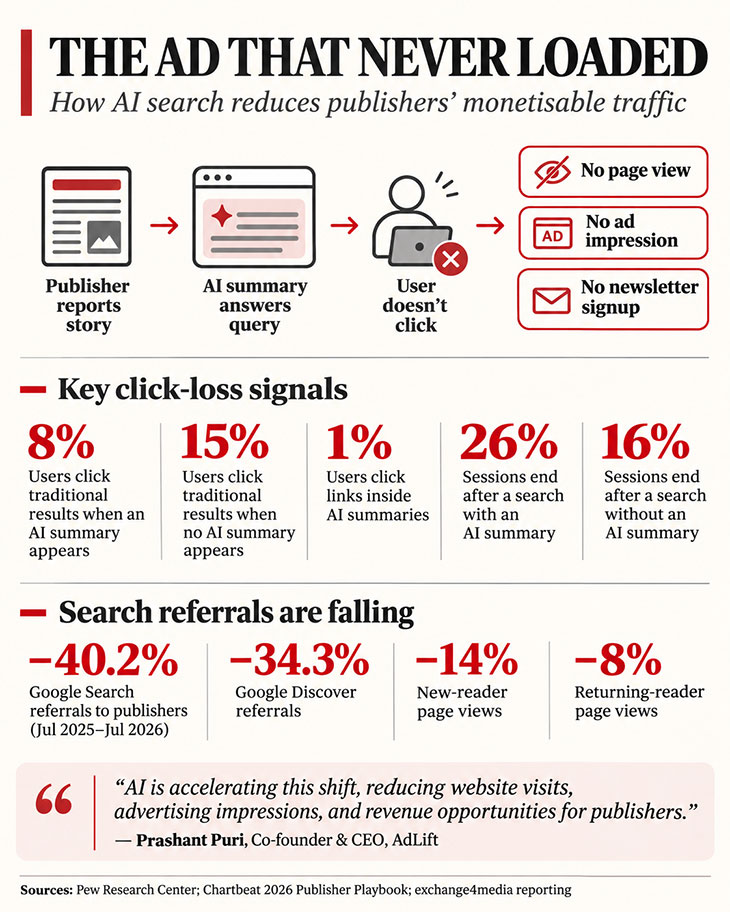
A Pew Research Center study found that users clicked traditional search results in just 8% of searches featuring Google AI summaries, compared with 15% without them. Links cited within AI summaries attracted clicks in only 1% of cases. Moreover, 26% of searches featuring summaries ended the browsing session, compared with 16% without.
Chartbeat's 2026 Publisher Playbook offers a broader picture. Across its network, Google Search referrals declined 40.2% year-on-year between July 2025 and July 2026, while Google Discover referrals fell 34.3%. Page views from new readers declined 14%, those from returning readers fell 8%, and average engaged time slipped from 26.7 seconds in the first half of 2024 to 24.3 seconds in the first half of 2026.
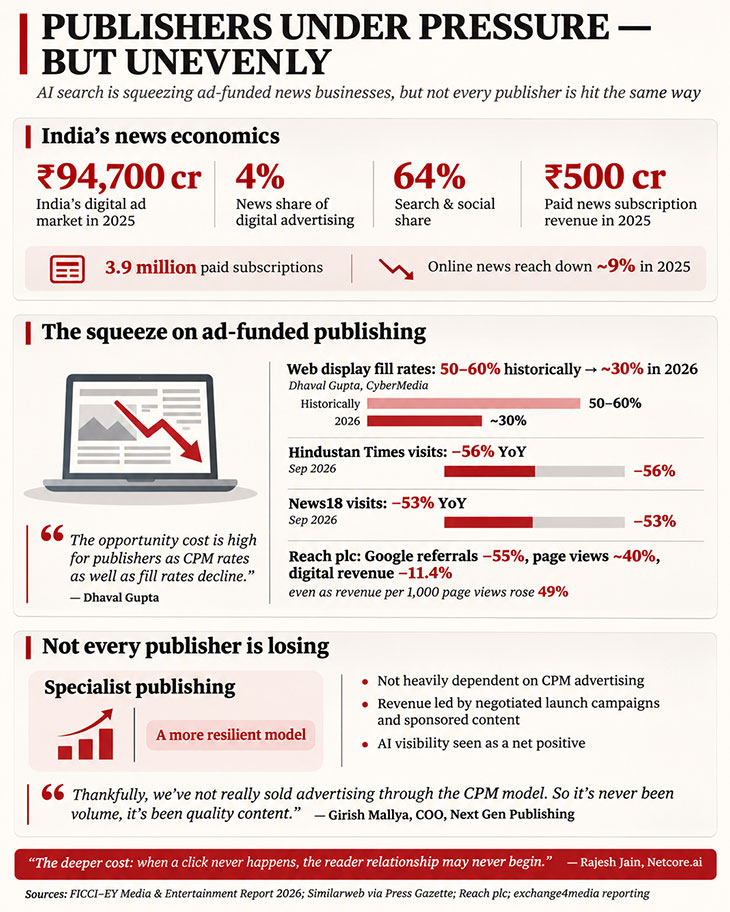
India is hardly immune. Similarweb estimates reported by Press Gazette showed visits to Hindustan Times falling 56% year-on-year in September 2026, while News18 recorded a 53% decline.
These figures cannot all be attributed to AI. Algorithm changes, reduced social referrals and zero-click searches preceded the chatbot boom.
Prashant Puri, Co-founder and CEO of AdLift, believes AI is accelerating these existing trends, particularly for publishers dependent on informational content.
"AI is accelerating this shift, reducing website visits, advertising impressions, and revenue opportunities for publishers," he said, adding that AI-search optimisation strategies are not yet generating sufficient referral traffic to compensate for disappearing search clicks.
Several major publishers contacted by exchange4media did not respond to requests for comment.
Fewer visitors, fewer advertisements
The economic implications extend beyond traffic charts. A missing visitor means fewer potential page views, fewer ad requests and, ultimately, fewer opportunities to earn advertising revenue.
Dhaval Gupta, Managing Director of CyberMedia, says the problem is compounded by deteriorating advertising yields and fill rates.
"The opportunity cost is high for publishers as CPM rates as well as fill rates decline," he said.
Since the beginning of 2026, Gupta says web display fill rates have hovered around 30%, compared with historical levels of 50–60%. Put simply, where 100 advertising requests might previously have resulted in 50–60 advertisements being served, that number is now closer to 30.
His observations are not a national benchmark, nor do they establish that AI alone is responsible. But they illustrate how declining traffic and weaker monetisation can compound the pressure on publisher revenues.
The deterioration extends beyond the number of advertisements being served.
Read: The great AI content glut: When everyone can make everything
Pradeep Gairola, Business Head of The Hindu Digital, had earlier told exchange4media that while digital advertising CPMs stood at around ₹100–110 in the mid-1990s, many leading Indian news publishers now operate at average yields of ₹70–80. For years, growing traffic and page views helped offset weaker pricing. But with many large publishers losing more than half their traffic over the past four to five years, that arithmetic is becoming increasingly difficult to sustain.
The problem, moreover, predates generative AI. Publishers have spent two decades depending on platforms to bring them audiences, often surrendering distribution control in the process
The contrast with India's wider advertising market is particularly striking.
According to the FICCI–EY Media and Entertainment Report 2026, India's digital advertising market grew 26% to ₹94,700 crore in 2025, accounting for 63% of the country's total advertising expenditure.
Yet news accounted for just 4% of digital advertising revenues, while search and social platforms commanded 64% and e-commerce and point-of-sale advertising captured another 23%.
EY estimates that the reach of online news platforms declined approximately 9% during 2025. Meanwhile, paid news subscriptions generated only around ₹500 crore from 3.9 million subscriptions, up from approximately ₹300 crore and 3.3 million subscriptions in 2024.
The report projects digital advertising will grow further to ₹1,10,900 crore in 2026. The question for publishers is how much of that expanding market they can actually capture.
Pankaj Srivastava, Founder and CEO of UnoSearch, points to UK publisher Reach plc as an illustration of how falling traffic can undermine revenues even when monetisation improves.
Reach's H1 2026 results showed Google referrals declining 55% and on-platform page views falling 40%. Indirect digital revenue declined 16.2%, even as revenue per thousand page views increased 49%. Overall digital revenue nevertheless fell 11.4%.
"Higher yields can partially compensate for declining inventory in the short term, but they cannot sustainably offset the loss of traffic and monetisable impressions over the long run," Srivastava said.
Piano's publisher benchmark offers a similar contrast: search traffic declined 36% during 2025, while revenue fell 16%.
The missing click, therefore, represents an opportunity cost rather than a fixed amount of lost revenue. Its value depends on the visitor, available inventory and the publisher's commercial model.
Not every publisher is losing
For Girish Mallya, COO of Next Gen Publishing and Editor & Publisher of T3 India, the experience has been markedly different.
"Thankfully, we've not really sold advertising through the CPM model. So it's never been volume, it's been quality content, which is going to target people who are genuinely wanting accurate, credible information," he said.
Next Gen's specialist titles, including Car India, Bike India and T3 India, primarily monetise through negotiated product-launch campaigns, sponsored content and advertising placements rather than impression-driven programmatic advertising or affiliate commissions.
Consequently, Mallya says the publisher has not experienced a meaningful AI-related decline in advertising revenue. He believes decades of editorial credibility are actually helping its publications surface in AI-generated responses and attract attention from prospective advertisers.
Read: AI can make infinite content. But can it make anyone care?
"So both from advertisers and readers, we are actually seeing a net positive of AI," he said.
While Mallya did not quantify that benefit, his experience challenges the assumption that every missing click carries the same commercial consequences.
His principal concern lies elsewhere: growing AI bot traffic consuming hosting resources without delivering corresponding human readership or advertising revenue.
Publishers, in other words, may increasingly incur costs supplying information to machines without receiving the commercial benefits of human visits.
The cost of the next investigation
Beyond the lost advertising opportunities lies a more difficult question: what happens to the journalism that those revenues were supposed to support?
Investigative and long-form reporting can require months of work, travel, specialist research and legal scrutiny, with costs incurred long before publication.
Yet there is a paradox. The Reuters Institute's 2026 survey found that publishers increasingly intend to prioritise original investigations and on-the-ground journalism, precisely because such work is harder for AI systems to replicate than routine informational content.
The challenge is financing that ambition. If an investigation's findings can reach millions through AI-generated answers without corresponding visits or revenue, its public value may remain considerable even as its commercial returns diminish.
The immediate casualty may be an advertising impression. The longer-term risk is an investigation that never gets commissioned.
The reader who never returned
Rajesh Jain, Founder and Managing Director of Netcore.ai, argues that the greatest opportunity cost may extend well beyond an individual advertising impression.
A visitor who never reaches a website cannot be converted into a newsletter subscriber, app user or loyal reader. Publishers lose not only immediate revenue but the potential lifetime value of that relationship.
"A known reader costs little to bring back. An anonymous one has to be re-earned through a search engine or paid for every time," Jain said, describing what he calls the "reacquisition tax".
Chartbeat's findings reinforce the importance of loyalty. While new and returning audiences declined, monthly page views from loyal readers remained broadly stable at around 15 billion between 2024 and 2026.
Netcore's proposed response involves building direct relationships through newsletters, push notifications and apps, reducing reliance on external search referrals.
Read: This festive season, brands are approving systems, not just ads
Jain cites one unnamed media publisher whose newsletter monetisation increased three- to fivefold after incorporating its Google Ad Manager inventory into newsletters. The publisher's identity and the measurement methodology remain unconfirmed, and the increase should not be confused with growth in overall publishing revenue.
Meanwhile, Srivastava cautions against treating AI-search visibility as a commercial achievement in itself. Citations within generated answers must ultimately translate into measurable referral traffic, audience relationships, subscriptions, sponsorships or licensing income.
The underlying bargain between information, distribution and advertising is being renegotiated, and its consequences are proving very different across publishing models.
Some publishers may find greater value in specialist expertise and direct commercial relationships. Others remain heavily dependent on a dwindling supply of monetisable visitors.
Search engines and AI platforms may still deliver the answers. Whether they deliver enough business to pay for the next story is another question.
Read more news about Digital Media, Internet Advertising, Marketing News, Television Media, Radio Media
For more updates, be socially connected with us onInstagram, LinkedIn, Twitter, Facebook, YouTube & Google News
